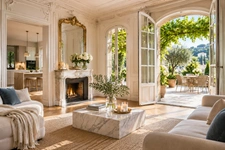
What Do International Buyers Really Want in a French Property?
A Haussmannian apartment, Belle Époque villa or Provençal bastide may immediately appeal to an international buyer. Yet French architecture and lifestyle alone are not always enough: today’s buyers increasingly look for a balance between authenticity, comfort, services and ease of ownership.
Paris and the French Riviera continue to attract buyers from across the world.
But “international buyers” are not one homogeneous group.
An American entrepreneur living in London with three children, a Swiss couple looking for a second home, a Middle Eastern family or a British retiree will naturally have very different expectations.
Nevertheless, several recurring trends can be identified.
Above all, international buyers are often attracted to France because it feels French, while still expecting some of the comfort standards to which they are accustomed.
French authenticity remains a major attraction
Original parquet floors, mouldings, fireplaces, high ceilings, stone façades, Belle Époque architecture, Provençal houses, shutters, Mediterranean gardens and Paris rooftops all contribute to the emotional appeal of French property.
International buyers rarely come to France looking for an exact replica of what they could purchase in London, Geneva, New York or Dubai.
They want character.
This is why the best renovations are not necessarily those that erase every trace of the past.
Preserving an original staircase, fireplace, façade or beautiful proportions can significantly strengthen a property’s appeal.
But buyers often want that authenticity combined with contemporary comfort.
Character does not mean accepting every inconvenience
Loving an old property does not necessarily mean accepting poor insulation, outdated plumbing, insufficient electrics or an impractical layout.
Air conditioning illustrates this perfectly.
For some buyers, it is an attractive extra.
For others, it is almost essential.
On the French Riviera, increasingly hot summers are also making air conditioning less of a cultural preference and more of a general comfort consideration.
The challenge in a character property is integration.
The best technology improves the experience of the home without visually dominating it.
Bedrooms and bathrooms reveal different living habits
A French family apartment may have four bedrooms and only two bathrooms.
Some international buyers will find this entirely normal.
Others will see it as an immediate drawback.
Buyers accustomed to en-suite bedrooms may expect a principal suite with its own bathroom and dressing area, together with greater independence for guest bedrooms.
This becomes particularly important for families who regularly host adult children, friends or relatives travelling from abroad.
The number of bedrooms therefore matters less than how independently those bedrooms can function.
Outdoor space needs to be genuinely usable
On the French Riviera, terraces, gardens and swimming pools have always been desirable.
But buyers increasingly assess them in terms of lifestyle rather than size alone.
A terrace deep enough for both dining and lounging, shade during the hottest hours, an outdoor kitchen, manageable landscaping or a well-positioned pool may all influence the decision.
A large garden is not automatically better.
For an owner spending only part of the year in France, 800 square metres of beautifully designed and manageable grounds may be far more attractive than several hectares requiring substantial maintenance.
Outdoor space is increasingly judged by how it can be lived in, not simply by how much of it there is.
Security, privacy and peace of mind
Security has become more prominent in international property decisions.
This does not necessarily mean high walls or visible surveillance.
It often means controlled access, discretion, remote monitoring, reliable smart-home systems and confidence that the property can be left unattended.
This is particularly relevant for second homes.
For many owners, being able to leave for several weeks knowing that the property, its systems and grounds are monitored is a genuine form of comfort.
And the best security is often the least visible.
“Lock up and leave” is becoming a luxury in itself
Ease of ownership is increasingly important.
A spectacular property may lose some of its appeal if managing it becomes a full-time occupation.
International buyers may therefore value:
secure residences;
concierge services;
property management;
technical maintenance;
manageable gardens;
reliable home automation;
the ability to prepare the property before arrival.
For some buyers, luxury is no longer simply about owning the largest house.
It is about being able to enjoy it without constantly managing it.
International accessibility becomes part of the property
For someone dividing their time between several countries, distance to an international airport can be almost as important as distance to the sea.
A beautiful property that is difficult to reach may quickly become less attractive in everyday use.
This is one of the French Riviera’s structural advantages: many very different residential markets remain within relatively easy reach of Nice Airport.
Paris naturally benefits from the same international connectivity.
Buyers therefore compare more than the properties themselves.
They compare flight connections, journey times, schools, healthcare, transport, restaurants, culture and everyday convenience.
Sometimes, saving thirty minutes on every journey matters more than gaining ten extra square metres.
Parking, lifts and storage: practical details that can decide a sale
The garage or wardrobe rarely creates the initial emotional connection with a property.
Yet such details can become decisive.
A charming Paris apartment without a lift may be entirely suitable for one buyer and completely impractical for another travelling with children, luggage or older relatives.
On the Riviera, parking is equally important.
Two cars, visitors, bicycles, scooters or rental vehicles can require far more space than expected.
Storage also matters for international owners who leave clothes, luggage, sports equipment and personal belongings in France between visits.
These features may not create the desire to buy. But their absence can stop the purchase.
Move-in-ready homes often have an advantage
International buyers are not necessarily opposed to renovation.
Some actively seek properties they can transform.
But managing architects, contractors, approvals and design decisions from another country can be demanding.
For many buyers, a beautifully renovated property that retains its architectural character therefore has a clear advantage.
The ideal combination is often: character + comfort + quality renovation + no immediate work required.
This does not mean every seller should renovate before going to market.
An overly personalised or standardised renovation may remove exactly what makes the property appealing.
Do nationalities really have different tastes?
Yes — but only to a point.
Cultural habits certainly exist.
Some American buyers may be more accustomed to air conditioning, large kitchens, generous wardrobes and en-suite bathrooms.
British buyers may be especially drawn to traditional French architecture and character homes.
Families from cultures where entertaining plays an important role may place greater emphasis on reception rooms, guest accommodation and privacy.
Northern European buyers may pay close attention to natural light, thermal comfort and energy efficiency.
But these patterns should never become stereotypes.
Lifestyle is usually more informative than nationality.
A 45-year-old entrepreneur with three children may share more needs with another international entrepreneur in the same situation than with a retired buyer from the same country.
The professional’s task is therefore to understand cultural differences without allowing them to define the client.
Better questions produce better advice
To understand an international buyer, it is often more useful to ask:
How much time will you spend in France each year?
Will this be a primary home, second home or family property?
Will you work from the property?
Do you entertain frequently?
How often will you travel internationally?
How many cars will you have?
Do you want to manage the property yourself?
Will you require staff or property management?
Which features are essential in your current lifestyle?
Those answers reveal far more than a passport.
What French sellers may need to see differently
An additional parking space.
A small bedroom with its own shower room.
A room that can become an office.
Discreet air conditioning.
Easy airport access.
Secure luggage storage.
Local property-management services.
A well-documented security system.
A French seller may regard some of these as secondary details.
For an international buyer, one of them may make the difference between two otherwise comparable properties.
That does not mean making a French home less French.
Quite the opposite.
What attracts international buyers to France is often exactly what cannot be found elsewhere.
The aim is to preserve that identity while understanding the practical barriers that may affect a decision.
My perspective
Having lived and worked abroad for many years taught me something important: working with international clients requires both understanding cultural differences and knowing when to forget them.
A buyer never purchases a property simply through the lens of nationality.
They buy with their personal history, family, professional life, habits and vision of what living in France will feel like.
They may fall in love with a home precisely because it is unlike anything they know.
And they may walk away from the same home because it simply does not fit their everyday life.
The professional’s role is not to decide “what Americans like” or “what British buyers want”.
It is to understand what should be preserved, what needs to be explained and what should be anticipated.
That balance between French character and international lifestyles is often where a successful transaction begins.
Frequently Asked Questions
What do foreign buyers look for in French property?
Location, character, renovation quality, outdoor space, security, accessibility and ease of ownership are among the most frequently observed priorities.
Do international buyers prefer renovated properties?
Often, particularly when they want to avoid managing major building work from abroad. Others actively seek renovation projects, depending on their goals and available time.
How important is airport access?
For buyers dividing their time between several countries, it can be a major factor. Direct flights and realistic door-to-airport journey times form part of the property’s practical appeal.
Should a French property be adapted to international tastes before sale?
Not necessarily. Over-standardising a home can remove the character that attracted international buyers in the first place. It is usually better to preserve identity while addressing genuine functional weaknesses.
Can nationality predict what a buyer wants?
Only to a limited extent. Family structure, age, work, travel patterns and intended use of the property are generally more informative.
Caroline Herbert
Real Estate Advisor – Character Properties & Luxury Real Estate
French & International Clients
Nice • French Riviera • Paris • Île-de-France