French mortgage rates in 2026: should you wait to buy or sell?
Should you wait for lower French mortgage rates before buying or selling in 2026? Not necessarily. Today’s rates remain well below those seen in the 1980s and early 1990s. Whether to proceed depends on the purchase price, available financing and intended ownership period.
For a character apartment, a family home or a property intended for long-term ownership, historical perspective helps put the recent increase in context. It supports a considered decision without making a return to rates close to 1% a prerequisite.
French mortgage rate history: what has changed since the 1980s?
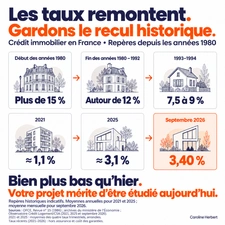
Historical records show how substantially French lending conditions have changed. Four reference points help put today’s mortgage rates in perspective:
Period | Observed rates | Type of reference |
|---|---|---|
Early 1980s | Above 15% for some mortgages | Historical lending conditions |
Late 1980s–1992 | Around 12% | Historical lending conditions |
1993–1994 | Between 7.5% and 9% | Historical lending conditions |
September 2026 | 3.40% | Monthly average across loan terms |
The first three references come from the French Ministry of the Economy archives. The latest comes from the Crédit Logement/CSA Observatory, September 2026, excluding borrower insurance and guarantee costs. Inflation and the economic environment were very different in earlier decades.
The Banque de France separately reported 3.32% for new housing loans excluding renegotiations in August 2026. This supports the broad picture, although the two figures cover different months and lending populations. Source: Banque de France, 6 October 2026.
Are French mortgage rates high compared with the past?
Rates close to 1% are a particularly low benchmark. Remembering them should not become the only way to assess whether a purchase makes sense.
Nor can we conclude that buying was necessarily harder in earlier decades. Property prices, household incomes, deposits and inflation have all changed. Historical lending conditions and current statistical averages are not a fully comparable series; the older sources do not consistently specify how insurance was treated.
The useful conclusion is narrower: a rate above its 2021 level does not automatically make a project unsuitable. It makes a careful assessment of the overall financial position essential.
Purchase price or mortgage rate: what changes the monthly payment?
Consider a hypothetical €500,000 repayment mortgage over twenty years. At a fixed annual rate of 3.50%, the monthly repayment is approximately €2,900. At 3%, it falls to roughly €2,773: a difference of about €127 per month.
Keeping the rate at 3.50% but borrowing €480,000 instead produces a monthly repayment of approximately €2,784. In this illustration, reducing the amount borrowed by €20,000 has a similar effect on the monthly payment to reducing the rate by half a percentage point on the original loan.
These calculations assume constant monthly repayments and exclude insurance, fees and guarantees. They demonstrate why the amount financed deserves as much attention as the interest rate. They do not imply that a price reduction is always available, or that the alternatives have identical total costs.
Buying a character property in France: which costs should you assess?
For a buyer, the assessment starts with the cash remaining after completion. Acquisition costs, identified renovation work, recurring expenses and a suitable contingency reserve all belong in the budget.
In an older apartment building, planned common-area works can materially affect the financial commitment. For a house, the roof, building systems and grounds deserve the same scrutiny. An appealing architectural feature may also bring practical responsibilities that should be assessed before making an offer.
Scarcity calls for discipline as well as attention. An open view or a well-designed family layout may be difficult to find again, but neither justifies an unlimited premium. Relevant completed sales, a documented assessment of condition and a financing review help distinguish a worthwhile opportunity from an expensive emotional decision.
When comparing French mortgage offers, the TAEG, or annual percentage rate of charge, includes interest and mandatory costs required to obtain the loan, including insurance and guarantees where required. It provides a broader comparison than the nominal rate alone. Source: Service Public, verified 16 April 2025.
Selling to buy in France: how much additional finance will you need?
The higher cost of a new mortgage may prompt a homeowner to postpone selling and buying their next home. This concern is best addressed through a complete financial comparison.
The useful measure is the amount needed to move from the current property to the next: sale proceeds after repaying the existing loan, the new purchase price, acquisition costs, works and additional borrowing. A concession on the sale price may sometimes be offset by the terms secured on the purchase. That relationship needs to be checked against the actual properties involved.
Timing matters too. What happens if the sale takes longer than expected, or achieves a lower price? Preparing these scenarios helps establish a sensible buffer and coordinate commitments with the lender and the notaire.
When does waiting for lower mortgage rates make sense?
Waiting can be sensible when it allows you to strengthen a deposit, stabilise income or clarify family plans. It then becomes a step towards a defined objective, with a date for reassessment.
Waiting solely for lower rates depends on an uncertain outcome. Buying on the assumption that a mortgage can later be renegotiated is equally fragile: the lender must agree, and fees may reduce the benefit. The project needs to remain affordable under the terms actually signed. Source: Service Public, verified 16 September 2026.
Frequently asked questions about French mortgage rates
Do historical mortgage rates include insurance?
The older sources do not consistently specify this. The recent Crédit Logement/CSA rate excludes borrower insurance and guarantee costs, so the historical comparison remains indicative.
Do lower rates guarantee a cheaper property purchase?
No. The property price, renovation costs and fees may change while you wait. Compare the overall cost of each scenario using clearly stated assumptions.
Which rate should you compare between French mortgage offers?
The TAEG compares interest and mandatory financing costs. Also review the loan term, guarantees and contractual conditions.
If you are considering selling or acquiring a character property, I would be pleased to discuss the property aspects of your plans, working alongside your lending and wealth advisers where appropriate.
Caroline Herbert — Property adviser - Tel/WhatsApp: +33 782 39 32 39 - [email protected]