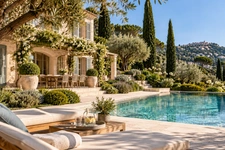
Pool, gardens, air conditioning, security, insurance and property management: discover the real annual cost of maintaining a luxury villa on the French Riviera in 2026.
How Much Does It Really Cost to Maintain a Luxury Villa on the French Riviera in 2026?
Pool, Mediterranean gardens, air conditioning, security, property management… The purchase price of a villa on the French Riviera is only the first line of the budget. How much should an owner realistically expect to spend each year to keep a luxury property at the standard that made it desirable in the first place?
When buying a high-end villa, attention naturally focuses on the purchase price, location, architecture, views and amenities.
Yet another question deserves to be asked almost immediately: what will this property cost once I own it?
A luxury villa is not simply a real-estate asset. It is also a collection of buildings, landscaped grounds, technical systems and services that need to be operated, monitored and maintained.
The Mediterranean climate adds specific challenges: heat, drought, vegetation management, strong winds, wildfire exposure and — close to the coast — salt-laden air.
The true cost of an exceptional property therefore cannot be assessed only on the day it is purchased.
It should also be measured by what is required to keep it exceptional ten years later.
Not every luxury villa has the same running costs
Two properties with identical asking prices may have completely different annual budgets.
A modern 250 sq m villa with a relatively compact landscaped garden and recent technical systems may cost considerably less to run than an older property of similar market value surrounded by several thousand square metres of mature grounds.
The main variables include:
living area;
size and complexity of the gardens;
swimming pool and equipment;
age of the building;
number of technical systems;
heating and air conditioning;
security;
staffing requirements;
frequency of occupation;
and, crucially, the owner’s expected standard.
In luxury real estate, the cost does not simply come from repairing things when they break.
Much of it comes from maintaining a consistently high standard.
1. The swimming pool: several thousand euros before major repairs
On the French Riviera, the pool is almost part of the classic villa image.
It is also a technical installation in its own right.
2026 estimates for the Riviera place professional maintenance of a conventional private pool at approximately €1,500 to €4,000 per year, before water, energy and occasional repairs.
Filtration, water treatment, cleaning, heating, automatic covers and more sophisticated equipment can push costs higher.
And routine expenditure does not include the longer-term items: pumps, filtration equipment, waterproofing, liners, heating systems or technical-room refurbishment.
The real cost of a pool should therefore be considered over ten years rather than twelve months.
2. The garden: perhaps the most underestimated expense
A perfectly maintained Mediterranean garden often looks effortless.
It is not.
Olive trees, citrus trees, palms, cypresses, sculpted hedges, flowering borders, lawns and irrigation systems require regular attention.
Local 2026 rates for professional garden maintenance around Nice commonly fall around €40 to €60 per hour, depending heavily on expertise, access, terrain and the work involved.
For a compact garden, a number of scheduled visits may be enough.
For a landscaped estate of 3,000 or 5,000 sq m, the economics are very different.
Tree maintenance, pruning, green-waste disposal, irrigation, replacement planting and specialist treatment can add up to many thousands — and sometimes tens of thousands — of euros per year.
There is also a distinctly Mediterranean issue: vegetation clearance for wildfire prevention.
French regulations impose mandatory vegetation clearance in many wildfire-exposed areas. Since 2025, buyers and tenants must also be informed when a property is located in an area subject to these legal requirements.
Following the wildfires of summer 2026, this is no longer simply a regulatory issue. It has become part of responsible Mediterranean property ownership.
3. Air conditioning and technical systems: comfort requires maintenance
A contemporary luxury residence may contain a significant amount of equipment:
multi-zone air conditioning, heat pumps, underfloor heating, ventilation, water treatment, outdoor lighting, motorised gates, shutters, irrigation, smart-home systems, temperature-controlled wine storage and sophisticated pool equipment.
Individually, each item may appear manageable.
Together, they form the villa’s technical infrastructure.
In 2026, routine air-conditioning maintenance typically costs a few hundred euros per system, with higher costs for complex multi-unit installations and in premium locations such as the French Riviera.
For a large villa, the issue is therefore not simply energy consumption.
It is the preventive maintenance of all the systems on which the comfort of the property depends.
And the most expensive breakdown is often the one that occurs in July, when the house is full.
4. Security and monitoring: the price of peace of mind
Alarm systems, professional monitoring, CCTV, video entry systems and access control represent another recurring expense.
Standard residential monitoring subscriptions may begin at a few tens of euros per month, but a substantial estate with multiple entrances, perimeter protection or on-site intervention naturally belongs to a different budget category.
Second homes may also require physical inspection visits.
An empty villa is never truly maintenance-free.
Someone may need to respond to a water leak, a power outage, an alarm, a faulty gate, storm damage or a pool problem.
The owner's absence does not eliminate running costs; it often creates an additional need for property management.
5. Property management: luxury also means arriving to a house that is ready
This is particularly important on the French Riviera, where many owners spend only part of the year in their property.
Professional property management may include:
regular inspections;
coordination of contractors;
access for maintenance teams;
responding to alarms and incidents;
preparing the villa before the owner arrives;
housekeeping and linen;
provisioning;
vehicle management;
monitoring the garden and pool.
Riviera property-management specialists make an important point: a villa occupied only a few weeks each year still needs to be managed during the many weeks when its owner is elsewhere.
And as expectations rise, the line between property management and private hospitality becomes increasingly blurred.
One notable 2026 trend in the Riviera’s ultra-prime market is stronger demand for renovated properties offering concierge-style services approaching five-star hotel standards.
6. Housekeeping and staff can completely change the budget
There is an enormous financial difference between a villa receiving occasional housekeeping and an estate employing a permanent housekeeper, caretaker, gardener or resident couple.
Once regular staff become part of the equation, the discussion moves beyond simple maintenance to the operation of a private property.
Even without permanent employees, a large villa may require substantial cleaning before and after each stay, as well as regular attention to windows, terraces, outdoor furniture and ancillary buildings.
The relevant question for a buyer is therefore not simply:
“Can I afford to purchase this property?”
It is also:
“What standard of service do I want to maintain once I own it?”
7. Insurance and climate exposure: an increasingly important issue in 2026
This has become particularly topical.
Since January 2025, the French surcharge financing the natural-catastrophe insurance scheme increased from 12% to 20% for property-damage insurance policies, directly influencing home-insurance premiums.
In June 2026, the French government also announced further measures designed to preserve the insurability of properties as climate risks evolve.
For a luxury home, premiums can vary enormously according to reconstruction value, location, pools and ancillary buildings, art, furnishings, security measures and natural-hazard exposure.
The useful question is therefore not:
“What is the average premium?”
but:
“Exactly what is insured, for what value and against which risks?”
8. The cost almost everyone forgets: future capital works
A property can be beautifully maintained while quietly accumulating future expenditure.
Roof.
Façades.
Terrace waterproofing.
Shutters.
Ironwork.
Retaining walls.
Irrigation.
Gate motors.
Pool pumps.
Air-conditioning.
Smart-home technology.
None lasts forever.
I would therefore always distinguish between two different budgets:
the annual operating budget, which keeps the home functioning;
and the long-term property budget, which covers systems and structural elements reaching the end of their life every five, ten or fifteen years.
A villa costing €20,000 a year to operate can still suddenly require €80,000 of capital work if several systems reach replacement age at the same time.
So how much should an owner budget each year?
There is no universal figure.
However, 2026 estimates for quality Riviera villas show that annual running costs in the tens of thousands of euros are entirely plausible once a property includes a pool, substantial landscaped grounds and regular services. One published estimate for quality villas in the Riviera hinterland puts overall annual running costs at around €26,000 to €42,000, depending on size, age and grounds.
As an indicative framework rather than a tariff, I would think in the following terms:
| Property profile | Indicative annual running budget* |
|---|---|
| 200–250 sq m villa, pool, manageable garden, no permanent staff | €20,000–€35,000 |
| 300–400 sq m villa, landscaped grounds, extensive equipment, regular management | €35,000–€70,000 |
| Large estate with extensive grounds, multiple systems and staff | €80,000+ |
*Indicative routine maintenance and operating budgets only. Financing, property taxes, major renovation and exceptional capital works are excluded.
At the ultra-prime end, of course, there is no meaningful ceiling. Permanent staff, human security, several hectares of landscaped grounds, spas, lifts, generators, collections, vehicle fleets or nautical equipment can completely change the economics.
Maintenance is also a way of protecting value
It would be a mistake, however, to treat every one of these expenses as money lost.
In luxury property, presentation and condition strongly influence perception.
A mature, beautifully maintained garden can take years to recreate.
Well-serviced pool equipment, air conditioning and technical systems reassure buyers.
Neglected façades, delayed waterproofing or ageing systems can create immediate suspicion about the rest of the property.
Maintaining a luxury villa properly is also about protecting its resale value.
My perspective
When advising on a high-end acquisition, I believe the future cost of the property should be discussed almost as early as potential renovation or interior design.
A home may fit a buyer’s acquisition budget perfectly while being far less compatible with the amount of time or money they wish to devote to maintaining it.
Conversely, a slightly more expensive villa that is technically sound, intelligently automated, surrounded by a manageable garden and supported by efficient property management can be far easier to own.
In luxury real estate, the real question is therefore not simply how much the house costs.
It is also:
how much does it cost to keep the house exactly as you fell in love with it?
That is a question worth asking before completion — not afterwards.
Frequently Asked Questions
What is usually the biggest maintenance expense for a French Riviera villa?
There is no single answer. For properties with extensive grounds, garden maintenance can dominate. For highly equipped villas, technical systems, energy and property management may represent the larger cost.
How much does pool maintenance cost on the French Riviera?
In 2026, professional routine maintenance is commonly estimated at around €1,500 to €4,000 per year, excluding water, energy and major repairs.
Is a second home more expensive to maintain?
Not necessarily in daily consumption, but the absence of permanent occupants often creates additional costs for monitoring, property management and preventive intervention.
Should buyers ask about running costs before purchasing a luxury villa?
Yes. Energy bills, pool and garden contracts, insurance, equipment history and recent maintenance records can provide valuable insight into the genuine cost of ownership.
Caroline Herbert
Real Estate Advisor – Character Properties & Luxury Real Estate
Nice • French Riviera • Paris • Île-de-France