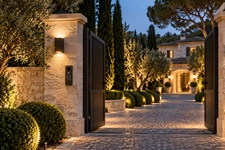
Access control, alarms, surveillance, smart-home systems, cybersecurity and privacy: how to secure a luxury property without compromising its architecture, comfort or appeal.
How to Secure a Luxury Property Without Turning It Into a Fortress
In luxury real estate, security has become part of comfort, just like privacy, quality of amenities and ease of access. Yet the best security is often the security you barely notice.
High walls, imposing gates and highly visible cameras were once the obvious symbols of a protected home.
Today, the approach is changing.
In its 2026 Luxury Outlook, Sotheby’s International Realty reported that 81% of the professionals surveyed viewed security as a major concern for luxury buyers. Access control, surveillance systems, backup power and, in some cases, dedicated safe areas are increasingly part of the conversation in high-end residential property.
But whether the property is a contemporary villa, a historic residence or a prime city apartment, protection should not come at the expense of architecture, light or quality of life.
The real question is therefore more subtle: how can a property be made genuinely secure without ever feeling like a fortress?
Security starts before choosing the technology
Not every luxury property faces the same risks.
A secluded estate covering several hectares does not require the same approach as a top-floor Paris apartment, a holiday home occupied only a few weeks each year or a villa located inside a gated and guarded estate.
Before discussing alarms or CCTV, it is essential to understand how the property is actually used.
Is it occupied all year?
Does it remain empty for long periods?
Do housekeepers, gardeners, pool contractors or maintenance teams regularly enter the property?
Does it contain works of art, jewellery, a wine collection, classic cars or other high-value assets?
Do the owners travel frequently?
Effective protection starts with understanding these patterns of use and the property’s real vulnerabilities.
In a high-end home, the best security system is not necessarily the most sophisticated one. It is the one that genuinely fits the property and the way its occupants live.
Protecting the perimeter without compromising the architecture
The first layer of protection often begins long before the front door.
Boundary walls, landscaping, exterior lighting, gates, garage access and circulation routes can all contribute to security while remaining discreetly integrated into the property.
In a contemporary villa, security systems can often be incorporated directly into the architecture from the design stage.
In a historic home or character property, the challenge is different. Original doors, shutters, ironwork and joinery may form an important part of the building’s identity and should not be altered carelessly.
This is where luxury requires a more refined approach.
A highly effective security installation that visually conflicts with a remarkable façade may protect the building while reducing both its aesthetic quality and, potentially, its heritage appeal.
The objective is not to make security visible.
It is to make it architecturally coherent.
Access control: who enters, when and why?
In some luxury properties, the number of people with legitimate access can be surprisingly large.
Family members, house staff, gardeners, pool technicians, caretakers, drivers, maintenance contractors, architects and guests may all require access at different times.
Traditional keys can quickly become difficult to manage.
Modern access-control systems make it possible to manage permissions more precisely and, when useful, to restrict them by area or time period.
Technology, however, does not replace good organisation.
When a property changes ownership, for example, resetting physical and digital access should be considered a basic security step.
This is particularly important for second homes, where several people may need to enter the property while the owner is away.
Alarms, surveillance and monitoring: think in layers
A coherent security strategy rarely depends on one device alone.
Perimeter protection, intrusion detection, exterior lighting, alarms, CCTV and professional monitoring are better understood as different layers of the same system.
For security equipment, recognised certifications can also help assess quality. In France, A2P certification, delivered by CNPP, applies to products such as locks, security doors, safes and certain security systems, while NF&A2P also covers electronic intrusion-detection equipment.
But, once again, the degree of sophistication should remain proportionate to the real need.
A highly complex installation that only a handful of technicians know how to operate can prove less practical — and sometimes less effective — than a simpler, well-designed system that is properly maintained.
In luxury residential property, ease of use is part of the quality of the installation.
A connected home can also become a vulnerable home
Security in a contemporary residence no longer concerns only doors and windows.
Cameras, connected locks, gates, heating, air-conditioning, lighting, shutters, intercoms, speakers, alarms and building-management systems may all be connected within the same digital environment.
That connectivity brings enormous convenience.
It also creates a new area of vulnerability.
France’s national cybersecurity agency, ANSSI, has repeatedly highlighted the potential weaknesses of connected devices, particularly when software updates, authentication and long-term security support are insufficient.
In a highly connected property, cybersecurity should therefore be considered from the moment the smart-home system is designed.
Choosing systems that will be supported over time, controlling remote access, applying updates and avoiding an accumulation of obsolete or incompatible devices becomes part of responsible property management.
The paradox is clear: the smarter a home becomes, the more carefully its digital security must be managed.
Continuity of operation: the often-overlooked issue
A highly technological property depends on power and connectivity.
What happens to the gate, alarm, certain locks, cameras or the home-automation system during a power outage?
This helps explain why backup power systems are increasingly mentioned among desirable features in high-end international properties.
This is not necessarily about planning for extreme scenarios.
In a second home located far from its owner, a prolonged power cut may be enough to disable systems or trigger alerts that are difficult to manage remotely.
Luxury property security therefore also involves resilience and continuity of operation.
Staff and contractors are part of the security equation
A large property can function almost like a small organisation.
Housekeepers, caretakers, gardeners, drivers, technicians and other contractors may have access to different parts of the home.
Security must therefore coexist with another fundamental requirement: respect for privacy.
In France, regulations also govern the use of private CCTV systems.
The CNIL states that homeowners may film the interior of their own property, including the house, garden and private access areas, but not public roads. The privacy of neighbours, visitors and people working in the property must also be respected.
Where staff are employed on site, cameras cannot be used to place employees under permanent surveillance while they work.
A sophisticated security system therefore does not give its owner unlimited freedom.
In a luxury home, security should protect the occupants’ privacy without unnecessarily infringing upon that of others.
Security and insurance are closely connected
Another issue is often discovered too late: the insurer’s requirements.
Where a property contains high-value assets or presents particular risks, some insurance policies may require specific protection measures for theft cover to remain fully effective.
Reinforced doors, window protection, alarm systems or other devices may therefore be required depending on the policy.
Works of art, jewellery, collections and other valuable possessions may also need specific declarations and suitable cover.
For a high-end property, the right question is therefore not simply:
“Am I insured?”
It is also:
“Do the actual characteristics of my property and the assets it contains still meet the conditions of my policy?”
A major renovation, a new art collection or the conversion of a second home into a primary residence may justify a fresh insurance review.
Showing too much security can also be counterproductive
Luxury real estate has another particularity: discretion matters during the marketing process.
There is little value in photographing every entrance, publicly explaining how the alarm system works or revealing the precise layout of technical or secure areas.
A buyer naturally needs to understand the property’s level of security.
But some information belongs in a confidential sales file, during a private viewing or in discussions that take place once the prospective buyer has been properly qualified.
This reflects a broader principle in the luxury market: not everything that adds value to a property needs to be made public.
Security is one of those elements.
Can good security increase the appeal of a luxury property?
Yes — provided it is well designed.
A modern, discreet, maintained and easy-to-use security system can reassure a buyer, particularly when the home is intended as a second residence.
It can also make daily life simpler and remote monitoring easier.
By contrast, an accumulation of outdated systems, visible wiring, mismatched cameras and obsolete technology can suggest that the entire installation will need to be replaced.
As with home automation, sophistication only creates value when it remains under control.
Secure without feeling confined: perhaps a new definition of luxury
The ideal luxury home should not make its occupants feel that they are living behind layers of protection.
It should simply allow them not to think about security.
Access is controlled.
The systems work.
Absences can be managed confidently.
Technology is integrated into the architecture.
Guests can be welcomed without unnecessary inconvenience.
Security remains discreet.
This may be where the real distinction lies between protection and genuine comfort.
My perspective
In high-end real estate, security can be difficult to assess during a first viewing.
Yet it contributes directly to the overall sense of quality.
A well-designed entrance, an absence of overlooking neighbours, controlled access, discreetly integrated equipment and the ability to close and secure the property easily before travelling all create a sense of reassurance.
These details are particularly important on the French Riviera, where many luxury homes are second residences and may remain unoccupied for part of the year.
For me, successful security is security that does not diminish the architecture, the landscape or the pleasure of living in the property.
In a remarkable home, you should not have to see the security. You should simply feel its presence.
Frequently Asked Questions
Does every luxury property need CCTV?
No. The appropriate level of protection depends on the location, the configuration of the property, how often it is occupied and the assets it contains. CCTV is only one possible layer of security.
Can smart-home technology improve security?
Yes. It can make it easier to monitor certain systems remotely and centralise alerts. But a highly connected home also needs strong cybersecurity and regular maintenance.
Can homeowners film the outside of their property?
In France, private individuals may film their own property, garden and private access areas, but not public roads. They must also respect the privacy of neighbours, visitors and staff.
Can security influence the value of a luxury property?
Security is rarely a standalone price driver, but a modern, discreet and coherent installation can make a property more attractive, particularly to international buyers and owners of second homes.
Caroline Herbert
Real Estate Advisor – Character Properties & Luxury Real Estate
Nice • French Riviera • Paris • Île-de-France