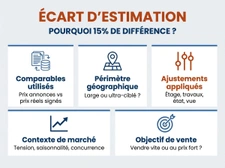
Discrepancy in property valuations: why two professionals can differ by 15%
When a seller requests multiple valuations for their property, significant discrepancies are not uncommon: 10%, 15%, sometimes even more. This situation can lead to confusion, even mistrust: "Who's right? Who's wrong?"
In reality, a difference in valuation doesn't necessarily indicate an error or an attempt at manipulation. It often reveals differences in methodology, scope of analysis, or strategic objectives.
This article explores the reasons behind these discrepancies and how to make an informed choice between several valuations.
1) The scope of comparables used
The valuation is largely based on the analysis of comparable properties recently sold or currently for sale. However, not all professionals use the same comparison criteria:
a) Advertised price vs actual selling price
Some rely on advertised prices (more accessible, but often overvalued). Others prefer the prices actually signed at the notary's office (more reliable, but less numerous and sometimes confidential).
b) Geographical scope
For a property in the 17th arrondissement of Paris, should one compare it with the entire arrondissement, or only the micro-neighborhood? For a property in Nice, should one include the city center and the promenade, or only the immediate street?
c) Reference period
Some analyze the last 3 months, others the last 6 or 12 months. Depending on market dynamics, this can generate discrepancies.
2) Adjustments to the property criteria
No two properties are ever perfectly identical. Therefore, an accurate valuation requires adjusting comparable properties based on specific criteria:
a) Floor and elevator
In Paris, a 5th-floor apartment without an elevator can be significantly cheaper than a 2nd-floor apartment with an elevator. Not all real estate agents apply the same adjustment factor.
b) General condition and works
A property "in need of renovation" vs. a property "completely renovated": what discount should be applied? 5%, 10%, 15%? The assessment varies depending on experience and knowledge of the local market.
c) Exposure, view, quiet
These subjective elements are difficult to quantify. Some professionals incorporate them cautiously, others more optimistically.
3) Taking into account the context and dynamics
The valuation is not limited to a mathematical formula. It also incorporates an analysis of the market at a specific point in time:
a) Supply/demand tension
If demand is high and supply is low, some professionals slightly increase their estimates. If the market is calmer, others prefer to remain cautious.
b) Seasonality
On the French Riviera, estimating a property in the middle of the summer season (high demand) or in winter (quieter) can influence its positioning.
c) Active competition
How many similar properties are currently for sale in the area? At what price? For how long? These factors influence the pricing strategy.
4) The strategic objective of the seller (and sometimes the professional)
Valuation is not just a technical exercise: it is part of a sales strategy.
a) "High" estimate for signing a mandate
Some real estate agents deliberately overvalue properties to entice sellers and secure the listing. The property doesn't sell, and a price reduction occurs a few weeks later. This practice is detrimental to everyone: the seller loses time, and the agent loses credibility.
b) "Conservative" valuation for a quick sale
Others prefer to slightly undervalue to quickly generate offers and close deals fast. This can work if speed is the priority, but sometimes leaves a feeling of missed opportunity.
c) "Well-reasoned" estimate to defend the price
A coherent estimate, neither optimistic nor pessimistic, makes it possible to generate qualified visits, to support the price in negotiation, and to reach a conclusion within a reasonable timeframe.
5) The difference between "price range" and "recommended price"
Some professionals offer a broad price range (e.g., "between €450,000 and €500,000"), while others specify a precise price (e.g., "€480,000").
A price range allows for flexibility but can also create confusion: which price should be used for the listing?
A precise price is clearer but must be justified: why this figure, and not 5% more or less?
6) Specifics of Paris/IDF and the French Riviera
Paris and the inner suburbs
The Parisian market is highly segmented: each arrondissement, even each street, has its own dynamics. A professional unfamiliar with the micro-sector can easily be off by 10%.
French Riviera
The Mediterranean coastline offers great diversity: Nice city center, the hills surrounding Nice, hilltop villages, the seafront… Price differences per square meter can be considerable over just a few kilometers. A general estimate loses its relevance.
7) How to decide between several estimates?
Faced with several conflicting estimates, here are some key points:
a) Request comparables
A serious professional should be able to justify their estimate with concrete examples of properties sold or for sale.
b) Analyze the method
How was the estimate calculated? What adjustments were made? What sales strategy is being proposed?
c) Evaluate the consistency with the objective
If the deadline is the priority, a conservative estimate may be appropriate. If maximizing the price is the objective, a more ambitious (but defensible) estimate may be justified.
d) Beware of extremes
An estimate that is significantly higher than the others should be questioned: is it realistic, or designed to be appealing?
Conclusion
A 15% difference between two estimates is not necessarily abnormal. It reflects methodological choices, varying levels of information, and sometimes diverging strategies.
The important thing is not to choose the highest or lowest estimate, but the one that is best supported by evidence, most consistent with the objective, and presented by a professional capable of defending it in negotiations.
For a precise and well-supported estimate in Paris/Île-de-France or the French Riviera, a consultation allows us to establish the framework, explain the methodology, and develop a sales strategy together.
Contact me:
Caroline Herbert - Real Estate Advisor (particularly in Paris/Île-de-France or the French Riviera) [email protected] Tel/WhatsApp: +33 7 82 39 32 39