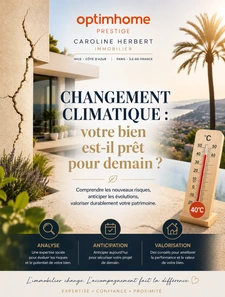
The Climate Is Changing… and So Is the Value of Your Property: What Homeowners Need to Know in 2026
Heatwaves, drought, cracks, clay soil zoning in 2026: discover how climate change is now influencing property values.
Ten years ago, very few buyers would ask whether a house stayed comfortable in summer, whether the land was built on clay soil, or whether repeated droughts could affect the foundations.
Today, these questions are becoming increasingly common.
Climate change is not only transforming the way we live. It is also gradually changing the way we buy, sell and assess residential property.
Longer heatwaves, repeated droughts, clay shrink-swell, flooding, wildfires, summer comfort, home insurance costs: all these topics are now entering real estate conversations.
Should homeowners be worried? Not necessarily.
Should they ignore these issues? Certainly not.
A property located in an exposed area, or affected by certain climate-related constraints, is not automatically devalued. However, it does need to be presented with method, precision and transparency.
This is where professional guidance becomes essential.
Climate Is Becoming a New Factor in Property Value
For a long time, three criteria dominated property valuations:
- location;
- surface area;
- overall condition.
These fundamentals remain essential. A good location, a well-designed layout, pleasant natural light and quality architecture continue to matter.
But a new criterion is gradually emerging: the ability of a home to remain desirable in a changing climate.
In other words, buyers are no longer only looking for a property that is pleasant today. They also want to know whether it will remain comfortable, safe, insurable and valuable tomorrow.
This shift is particularly visible in the residential and patrimonial markets, where buyers often take a long-term view.
A primary residence, a family home, a second home on the French Riviera or a quality apartment in Paris is not just a place to live. It is also a long-term asset. And like any asset, it needs to be protected.
Buyers No Longer Ask Exactly the Same Questions
Property viewings have changed.
In the past, questions mainly focused on service charges, schools, the co-ownership, public transport or decorative works.
Today, other concerns are emerging.
Before | Today |
|---|---|
How many bedrooms are there? | Will the home remain comfortable when it is 38 or 40°C outside? |
Is the living room bright? | Are the bay windows properly protected from the sun? |
What is the EPC rating? | Does the home offer good summer comfort? |
Is the terrace large? | Can it actually be used in August? |
Are there any works to plan? | Do the works improve the performance and resilience of the property? |
Is the neighbourhood sought-after? | Is the area exposed to any particular risk? |
This does not mean that buyers are becoming anxious. It simply shows that they are better informed.
And a better-informed buyer expects clear answers.
Five Climate-Related Criteria That Matter More and More
1. Summer Comfort
For many years, energy performance was mostly associated with heating.
Today, summer comfort has become a major topic.
A home can perform well in certain energy-related areas and yet become difficult to live in during heatwaves if it is poorly ventilated, overly exposed or insufficiently protected from the sun.
Buyers are increasingly looking at:
- orientation;
- natural ventilation;
- shutters, blinds or sunshades;
- roof insulation;
- reversible air conditioning;
- outdoor vegetation;
- shaded areas.
On the French Riviera, this criterion is already essential. In Paris and Île-de-France, it is also becoming increasingly important, especially for top-floor apartments, attic apartments or highly exposed buildings.
A dual-aspect apartment, a well-ventilated house or a shaded terrace are no longer just pleasant features. They are real selling points.
2. Clay Shrink-Swell
This is one of the most sensitive topics at the moment.
Some clay soils shrink when they dry out, then swell again when humidity returns. These movements can affect buildings, especially individual houses: cracks, distortions, or difficulties opening doors and windows.
The phenomenon is not new, but successive droughts have made it more visible.
It naturally raises questions during a sale.
A crack does not necessarily mean that a house is dangerous. Some cracks are superficial. Others require expert assessment. What matters is understanding their origin, their evolution and any solutions that have been implemented.
3. Natural Risks
Flooding, wildfires, ground movement, coastal erosion, seismic risk, radon, soil pollution: natural and environmental risks may form part of the information provided to a buyer.
In France, the “État des Risques” — the official risk statement — is an important document in the sale file when the property is located in a relevant area.
But beyond the legal requirement, the quality of the explanation makes all the difference.
An identified risk that is clearly explained and put into context can be better accepted than information discovered late or presented poorly.
4. The Cost of Home Insurance
The cost of climate-related claims is increasing, and insurers are gradually adapting their risk analysis.
The most attentive buyers are therefore also considering insurance: claim history, natural disaster recognition, completed works and exposure of the property.
This topic does not necessarily prevent a sale, but it can influence the buyer’s overall perception of risk.
5. Works Already Carried Out
Improvement works now carry a new significance.
Insulation, roofing, windows, shutters, air conditioning, heat pumps, pergolas, landscaping, rainwater management: these are no longer just technical details.
They tell the story of the property.
They show that it has been maintained, adapted and protected.
When selling, invoices, warranties, diagnostics and technical documents therefore become valuable assets. They turn a simple statement into evidence.
New Clay Soil Zoning in 2026: What Changes from 1 July
This is one of the key updates for homeowners in 2026.
From 1 July 2026, a new national zoning map for exposure to clay shrink-swell comes into force.
This update takes into account the claims observed in recent years and the latest knowledge regarding soil behaviour.
The figures are significant:
- areas classified as medium or high exposure now represent 55% of mainland France, compared with 48% previously;
- approximately 12.1 million existing individual houses are concerned, representing more than six out of ten individual houses.
This new zoning does not mean that all these houses are fragile or difficult to sell. It means that more areas are now officially recognised as exposed to a phenomenon that needs to be taken into account.
That distinction is important.
What Are the Practical Consequences?
The new zoning applies in particular to preliminary sale agreements or final deeds of sale for unbuilt buildable land, as well as to contracts for the construction of individual houses concluded from 1 July 2026.
In areas with medium or high exposure, this may require a geotechnical soil study or the use of appropriate construction techniques, depending on the case.
For existing properties, this update does not create a new general obligation for all sellers of already-built houses.
However, it will make buyers more attentive.
They will want to know whether the property is located in an affected area, whether cracks have been observed, whether works have been carried out, whether an expert report exists, or whether the property has previously been recognised as affected by a natural disaster.
In other words, information becomes a tool for building trust.
Did You Know?
Clay shrink-swell is now one of the major prevention topics for buildings facing climate change.
But being located in a clay soil area does not mean that a property is unsellable, nor does it mechanically reduce its value.
What can weaken a sale is not so much the existence of a risk, but the absence of clear answers.
A buyer can understand many things. What they accept less easily is uncertainty.
What Can Enhance a Property… and What Can Weaken It
What Reassures and Adds Value | What Can Raise Concerns or Open Negotiation |
A complete technical file | Unexplained cracks |
Invoices for completed works | Works without supporting documents |
An available study or expert report | Approximate answers |
Good ventilation and sun protection | Overheating in summer |
A landscaped garden or shaded terrace | Outdoor spaces difficult to use in hot weather |
A consistent and well-explained EPC rating | Poor understanding of the property’s performance |
Transparent information on risks | Late discovery of a constraint |
Transparency is not an obstacle to selling. Very often, it is what helps secure the transaction.
Nice and the French Riviera: When Comfort Becomes an Expected Luxury
In Nice and across the French Riviera, buyers still seek everything that makes the local market so desirable: light, the sea, open views, terraces, gardens, swimming pools and the Mediterranean lifestyle.
But expectations are changing.
A south-facing terrace with no shade may look attractive in photos, but less so at 2 p.m. in the middle of August. A landscaped garden, a well-designed pergola, good natural ventilation or discreet air conditioning can therefore become real selling points.
For houses and villas, buyers are also paying closer attention to:
- water management;
- land maintenance;
- wooded surroundings;
- wildfire risk;
- ground movement;
- access quality.
In the prestige market, this shift is even more noticeable. Clients are looking for beauty, of course, but also comfort, durability and control.
Tomorrow’s luxury may not only be a sea view. It may also be a home where you can breathe comfortably in the middle of summer.
Ideally with a chilled glass of rosé in the shade. Although, admittedly, no diagnostic report measures that yet.
Paris and Île-de-France: Urban Heat, EPC Ratings and Clay Soils
In Paris and Île-de-France, the issues are different but just as real.
Summer comfort is becoming increasingly important in top-floor apartments, poorly insulated older buildings or highly mineral urban neighbourhoods.
A bright top-floor apartment may remain very desirable, but buyers are asking more questions about the indoor temperature during heatwaves.
Properties with good ventilation, improved insulation, effective shutters or a co-ownership that is proactive on energy works are perceived more positively.
In certain parts of Hauts-de-Seine, Val-de-Marne and, more broadly, the Paris Basin, the question of clay shrink-swell may also arise for individual houses.
Again, the point is not to alarm, but to anticipate.
A serious valuation must take into account the local market, the quality of the property and these new decision-making criteria.
Seven Questions to Ask Before Putting Your Property on the Market
Before publishing a listing, it is useful to ask a few simple questions:
- Does my property remain comfortable during heatwaves?
- Is my property located in an area subject to an identified natural risk?
- Have I kept invoices for completed works?
- Can I explain the origin of any cracks?
- Is my diagnostic file complete and up to date?
- Which features of my property will reassure buyers?
- Does my asking price reflect current market expectations?
These questions help prepare a smoother, more credible and often more effective sale.
Why Professional Guidance Is Becoming Essential
The role of a real estate adviser is no longer simply to estimate a price and organise viewings.
Today, a property must be understood as a whole: its address, architecture, environment, history, works, strengths, possible constraints and value potential.
It also means anticipating buyers’ questions.
A seller may be tempted to minimise certain issues for fear of alarming buyers. In practice, the opposite is often true: what is clearly explained is usually less worrying than what appears to be hidden.
Professional guidance helps to:
- highlight the property’s genuine strengths;
- prepare answers to sensitive questions;
- gather useful documents;
- adjust the pricing strategy;
- avoid last-minute negotiations;
- secure the transaction.
In a more demanding market, trust becomes a very tangible value.
FAQ — Climate Change and Real Estate
Is a house located in a clay soil area more difficult to sell?
Not necessarily. A large part of the country is concerned. What matters is the quality of the file, the real condition of the property, any expert assessments and the transparency of the information provided to the buyer.
Does the 2026 clay soil zoning reduce property values?
No, not automatically. It improves knowledge of exposed areas. It may lead to more questions from buyers, but it does not determine a property’s value on its own.
Does a crack always mean a serious problem?
No. Some cracks are superficial. Others may reveal a more serious movement. It is recommended to have them assessed if they are significant, evolving or numerous.
Should I carry out a soil study before selling?
For an existing house, it is not always required. For buildable land located in a relevant area, obligations may apply. In some cases, however, a study or expert assessment can help reassure buyers.
Does summer comfort really influence the price?
Increasingly so. A property that remains pleasant during heatwaves can be perceived more favourably, particularly on the French Riviera, in Paris and in dense urban areas.
Are apartments affected by climate change?
Yes, but differently. They may be affected by urban heat, EPC ratings, insulation, ventilation, the co-ownership’s management or certain natural risks depending on their location.
Can home insurance become an issue during a sale?
Yes. Buyers are paying more attention to the overall cost of owning a property, including insurance, especially if the area is exposed to certain risks.
How can I properly prepare the sale of a property in this context?
By gathering diagnostics, invoices, documents relating to works, information on risks and by building a transparent yet value-enhancing presentation of the property.
Conclusion: Selling Better Does Not Mean Hiding Sensitive Topics. It Means Mastering Them.
Climate change is gradually transforming the way we live, invest and sell.
It should not be seen as a systematic threat to property values. Rather, it should be understood as a new way of assessing real estate.
A well-located, well-maintained, well-documented and well-presented property still has strong advantages.
But buyers now expect more than an attractive listing. They want to understand what they are buying.
They want to feel reassured.
They want to be able to imagine their future there.
Because a property can no longer be reduced to an address or a surface area, every valuation today deserves a global analysis, taking into account market realities, the property’s characteristics, its environment and buyers’ new expectations.
Are you considering selling a property in Nice, on the French Riviera, in Paris or in Île-de-France?
I can support you with a well-argued valuation, a tailored marketing strategy and attentive guidance, in order to enhance the value of your property with rigour, transparency and peace of mind.
Contact-me:
Caroline Herbert - [email protected] - Tel : 07 82 39 32 39
Sources et ressources utiles
- Service-Public.fr — Nouveau zonage d’exposition au retrait-gonflement des argiles à partir du 1er juillet 2026.
- Géorisques — Cartographie du retrait-gonflement des argiles et information acquéreur-locataire.
- BRGM — Évolution de la carte nationale d’exposition au retrait-gonflement des argiles.
- Ministère de la Transition écologique — Diagnostic de Performance Énergétique et confort d’été.
- Météo-France — Impact du changement climatique sur les vagues de chaleur.
- France Assureurs / Observatoire national des risques naturels — Risques climatiques, assurance et coût des sinistres.