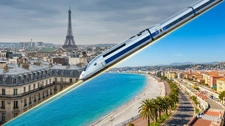
Urban Exodus Paris Nice 2026: Remote Work, City Return or Permanent Move? The Real Estate Reality Check
In 2020, as the first lockdown ended, headlines multiplied: "massive urban exodus," "fleeing big cities," "remote work revolution." Six years later, in 2026, now that the dust has settled and the numbers speak, what's the real story? Between myth and reality, has real estate in Paris, Île-de-France, and the French Riviera really experienced the predicted rupture? Who left, who came back, who stayed? And most importantly, how do these changes impact your buying or selling projects today?
As a real estate consultant specializing in Paris, Île-de-France, and Nice/French Riviera, I witness these transformations daily. Far from simplistic narratives, reality is far more nuanced. Let's decode together what really happened.
Urban Exodus: What the 2026 Numbers Really Tell Us
Studies Put the Phenomenon in Perspective
Contrary to the alarmist predictions of 2020, there was no massive urban exodus in France. Multiple studies converge: the PUCA report (Plan Urbanisme Construction Architecture) even speaks of "small flows, big effects." Concretely, a relatively small number of city dwellers with strong purchasing power was enough to destabilize certain local real estate markets, without emptying the metropolises.
One particularly revealing figure: according to a mobility barometer published in spring 2026, departures from Paris dropped by 41% between 2022 and 2025. The trend effect has faded, replaced by a more pragmatic and thoughtful approach.
Even more surprising: nearly 18% of households who left major urban areas between 2020 and 2022 now wish to move back. The reasons? Social isolation, commuting fatigue, difficulty for spouses to find stable employment, distance from essential services (healthcare, schools, culture).
Hybrid Remote Work: The New Stabilized Normal
Remote work, the major trigger of the movement, has also stabilized. In the first half of 2024, 22% of private sector employees worked remotely, with a well-established average of 1.9 days of remote work per week.
Far from the generalized "full remote" dreamed of in 2020, it's the hybrid model that has prevailed: two to three days per week at home, the rest at the office. This format changes the real estate game, but less radically than anticipated. No need to flee 500 km away, but the desire for a home office, a balcony, or a garden remains very present.
Paris and Île-de-France: Who Left, Who Came Back, Who Stays?
Inner Paris: Rebound and Resilience
Paris proper experienced a slight dip between 2020 and 2022, but the capital quickly rebounded. Prices stabilized, even rising again in certain sought-after districts (7th, 16th, 18th). Why? Because Paris remains Paris: access to qualified jobs, culture, healthcare services, elite schools, transport infrastructure.
The profiles who stayed or came back?
- Young professionals and executives whose careers require regular office presence
- Singles and couples without children who favor urban excitement
- Affluent families attached to Parisian academic and cultural excellence
Inner Suburbs: The Winning Compromise
The inner suburbs (Hauts-de-Seine 92, Seine-Saint-Denis 93, Val-de-Marne 94) proved to be the ideal compromise for many households: more affordable prices per m² than Paris, more generous spaces (gardens, terraces), while maintaining quick access to the capital via public transport.
Cities like Montreuil, Pantin, Issy-les-Moulineaux, Boulogne-Billancourt, or Saint-Mandé experienced real growth. Here, no brutal rupture, but reinforced attractiveness, especially for families with children and part-time remote workers.
Outer Suburbs: Confirmed but Nuanced Attractiveness
The outer suburbs did indeed welcome new residents, but not in the fantasized proportions. Well-connected medium-sized cities (Versailles, Saint-Germain-en-Laye, Fontainebleau, Rambouillet) came out ahead. However, very isolated rural areas saw some "urban refugees" turn back, confronted with daily reality: exhausting commutes, distant services, hidden costs (fuel, maintenance, heating).
The real estate market normalized after sometimes double-digit increases observed in 2020-2022. Today, selling or buying in the outer suburbs requires a refined approach: everything depends on connectivity, local services, and the real capacity to work remotely long-term.
Nice and the French Riviera: New Land of Welcome or Temporary Bubble?
The Riviera Coast: Sustained Attractiveness
Nice, Cannes, Antibes, Villefranche-sur-Mer... The French Riviera has indeed captured part of the Parisian departures. The exceptional lifestyle (climate, sea, culture, gastronomy) combined with the rise of remote work has attracted an affluent clientele, often senior executives or self-employed professionals.
But again, no tidal wave. Prices, already high (between €5,800 and €7,200/m² in Nice), experienced moderate growth. Buyers are selective, demanding, and the prestige market remains highly qualitative. The typical profile? A Parisian couple, fifties, able to work remotely 3 days a week, looking for an apartment with sea-view terrace or a villa with garden.
The Hinterland: Between Enthusiasm and Reality Check
The Nice hinterland (Vence, Saint-Paul-de-Vence, Grasse, Valbonne) also experienced renewed interest. Here, prices remain more accessible than by the sea, while offering Provençal charm and quality of life.
However, some Parisian buyers underestimated car dependency, distance from shops, difficulty accessing elite schools or specialized hospitals. Result: some properties came back on the market after only 2-3 years, sold by disillusioned owners.
Bi-Residentiality: The New Winning Model
The real winner on the French Riviera is bi-residentiality: keeping a pied-à-terre in Paris (or close suburbs) and acquiring a primary or secondary residence in Nice. Thanks to TGV connections (Paris-Nice in 5h30-6h) and low-cost airlines, this hybrid model increasingly attracts executives and active retirees.
This trend creates a specific real estate market: strong demand for "move-in ready" properties, well-connected (fiber, train stations, airport), with spaces adapted to remote work (office, brightness, quiet).
Tips for a Successful 2026 Real Estate Project
If You're Selling in Paris or Île-de-France
1. Highlight Urban Assets
Don't align with an "anti-city" narrative. On the contrary, showcase what makes your property strong: proximity to transport, shops, schools, culture, jobs. These assets are becoming decisive again.
2. Optimize Remote Work Space
Set up (even symbolically) an office corner, showcase natural light, fiber optic, quietness. Buyers seek "remote-work-friendly" properties.
3. Perfect the Presentation
Home staging, professional photos, virtual tours: in a normalized market, that's what makes the difference for a quick sale at the right price.
If You're Buying on the French Riviera
1. Test Before Buying
If you're coming from Paris or elsewhere, rent first for 6 to 12 months. You'll discover daily reality: commutes, climate (mistral, summer heat), social life, access to services.
2. Check Connectivity
Fiber optic essential if you work remotely. Also check proximity to TGV station or airport if you maintain Parisian activity.
3. Factor in Total Budget
Property tax, condo fees, heating/air conditioning costs, pool/garden maintenance... Real cost can exceed your initial estimate by 20 to 30%.
4. Beware of Energy Performance
Energy inefficient properties (F and G ratings) are increasingly difficult to finance and resell. Systematically request the energy audit and integrate renovation costs into your plan.
If You're Seeking the City/Nature Balance
1. Favor Well-Connected Medium Cities
Choose towns offering the best compromise between quality of life and metropolis accessibility. In Île-de-France, cities like Melun, Mantes-la-Jolie, or Provins combine pleasant settings and more affordable prices. On the French Riviera, the hinterland (Vence, Grasse, Valbonne) or cities like Fréjus or Saint-Raphaël offer an interesting balance. Highly sought-after cities like Versailles, Fontainebleau, Aix-en-Provence, or Antibes certainly offer exceptional quality of life and excellent connectivity, but at prices rivaling central Paris or Nice.
2. Formalize Your Remote Work
An amendment to your employment contract officializing your remote work days will reassure banks and secure your project.
3. Build a Contingency Fund
Moving, renovations, adaptation, unforeseen events... Plan for 10 to 15% of your purchase budget in reserve.
Mini FAQ: Urban Exodus and Real Estate in 2026
Did the urban exodus really happen?
Yes, but in a limited and nuanced way. No "massive flight," but targeted movements, often reversible.
Does remote work really change the real estate game?
Yes, but in hybrid mode (1 to 2 days/week). The impact is real but measured: need for an office, outdoor spaces, but not necessarily leaving the city.
Should you still invest in Paris in 2026?
Absolutely. Paris remains a safe haven, with sustained rental and purchase demand, especially in prestige and well-served neighborhoods.
Is the French Riviera accessible for a primary residence project?
Yes, if your professional situation allows it (remote work, self-employment, active retirement) and if you've tested the lifestyle first. Bi-residentiality is an increasingly popular option.
What are the pitfalls to avoid in 2026?
Underestimating total budget (mobility, energy, taxes), neglecting energy performance, buying without testing the lifestyle, and reselling too quickly (high transaction costs).
Conclusion: A Mature and Selective Real Estate Market
Six years after the Covid shock, the French real estate market has regained its balance. The urban exodus, far from being the predicted tsunami, proved to be a selective movement, often temporary, which nevertheless reshuffled some cards.
In Paris as in Nice, on the French Riviera as in Île-de-France, opportunities exist for those who know how to identify them. But succeeding in your 2026 project requires expertise, personalized support, and long-term vision.
📞 Do You Have a Real Estate Project in Paris, Île-de-France, or the French Riviera?
I support you with professionalism, listening, and in-depth knowledge of the ground to succeed in your purchase or sale in this changing context.
📧Email: [email protected]
📱Phone: +33 (0)7 82 39 32 39